If the thought of going to the dentist makes your chest tighten, your palms sweat, or your mind immediately start searching for reasons to reschedule, I want you to know something before we go any further:
You are not difficult. You are not unusual. And you are certainly not the only one.
Over the years, I have met many patients who were convinced they were simply "bad at the dentist." Some had avoided dental care for years. Others had experienced painful or frightening treatment in the past. Some could sit in the parking lot but could not quite bring themselves to walk through the door.
And many of them eventually became comfortable dental patients — not because they were forced through their fear, not because someone told them to "just relax," and not necessarily because they were sedated. They became comfortable because we slowed things down, listened to what they had been through, gave them control over the process, and allowed trust to develop at their pace.
At Living Dental Health in Bend, Oregon, that is how we think about dental anxiety. Sedation can absolutely help when it is needed. But for many people, the first and most important step is much simpler: finding a dentist who takes your fear seriously.
Dental Anxiety Is More Common Than Most People Realize
If you are embarrassed about being afraid of the dentist, please do not be. Dental fear is genuinely common — by one Cleveland Clinic estimate, about 36% of people in the U.S. have some fear of dental treatment, ranging from mild nervousness to a severe phobia that can make seeking care feel nearly impossible.
The problem is that fear often creates a cycle. You are anxious about going to the dentist, so you put off an appointment. A small problem quietly becomes a larger one. Eventually, discomfort or pain forces you to make an appointment, but now the treatment may be more involved than it would have been earlier. That experience reinforces the belief that dental visits are something to fear, and the cycle begins again. In fact, the ADA notes that the more you delay or avoid the dentist, the higher your risk of developing problems that make future visits even harder.
I have seen this happen many times. I have also seen the cycle broken. The goal is not to shame someone for waiting too long or lecture them about what they "should have done." The goal is to meet them where they are today and figure out the most comfortable way forward. That is one of the reasons we believe so strongly that not all dentists have to be terrifying.
Where Does Fear of the Dentist Come From?
For many anxious patients, there is a story behind the fear. Sometimes it started with a painful childhood dental experience. Sometimes a patient felt trapped in the chair or ignored when they tried to tell someone they were uncomfortable. Sometimes treatment moved too quickly and no one took the time to explain what was happening. And sometimes the fear simply grew over the years.
Dentistry was also very different a generation or two ago. The technology was different. The techniques were different. Expectations around communication and patient comfort were different. Those experiences can stay with people for decades.
We wrote more about that history in How the Heck Did Dentists Become So Scary?, but the important thing to understand is this: your fear probably came from somewhere. And when we understand where it came from, we can often build a completely different kind of dental experience around it.
For Most Anxious Patients, the Best Medicine Is Time
Sedation dentistry gets a lot of attention, but I want to be honest about something. For many people with dental anxiety, the most important thing we can give them is not medication. It is time.
Time to talk. Time to ask questions. Time to tell us what happened in the past. Time to understand what we are going to do before we do it. And time to realize that no one in our office is going to rush them, judge them, or surprise them.
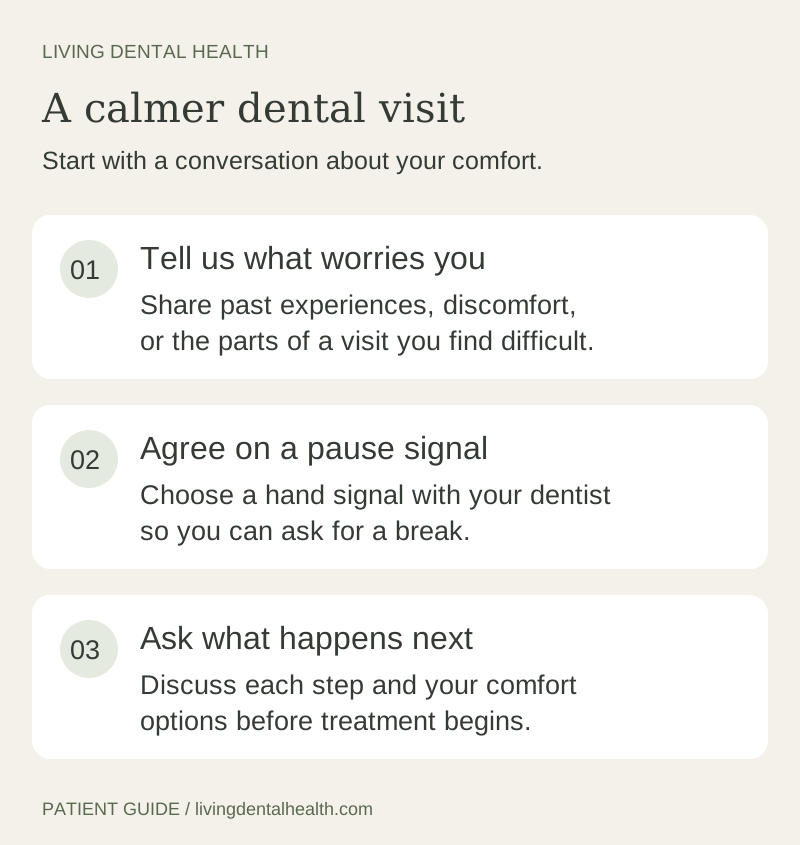
When you understand what is happening and know that you can communicate with us at any point, the entire experience begins to change. That is why I like to spend time talking with new patients before we jump into the clinical part of an appointment. For someone with significant anxiety, we can take that even further.
Terrified of the Dentist? Come Meet Us Without Getting in the Chair.
One of the simplest things we offer may also be one of the most helpful. If you have significant dental anxiety, you can start with a complimentary 15-minute meet and greet.
No dental treatment. No instruments. No pressure. I do not need to look in your mouth, and you do not need to commit to anything. We simply sit down and talk.
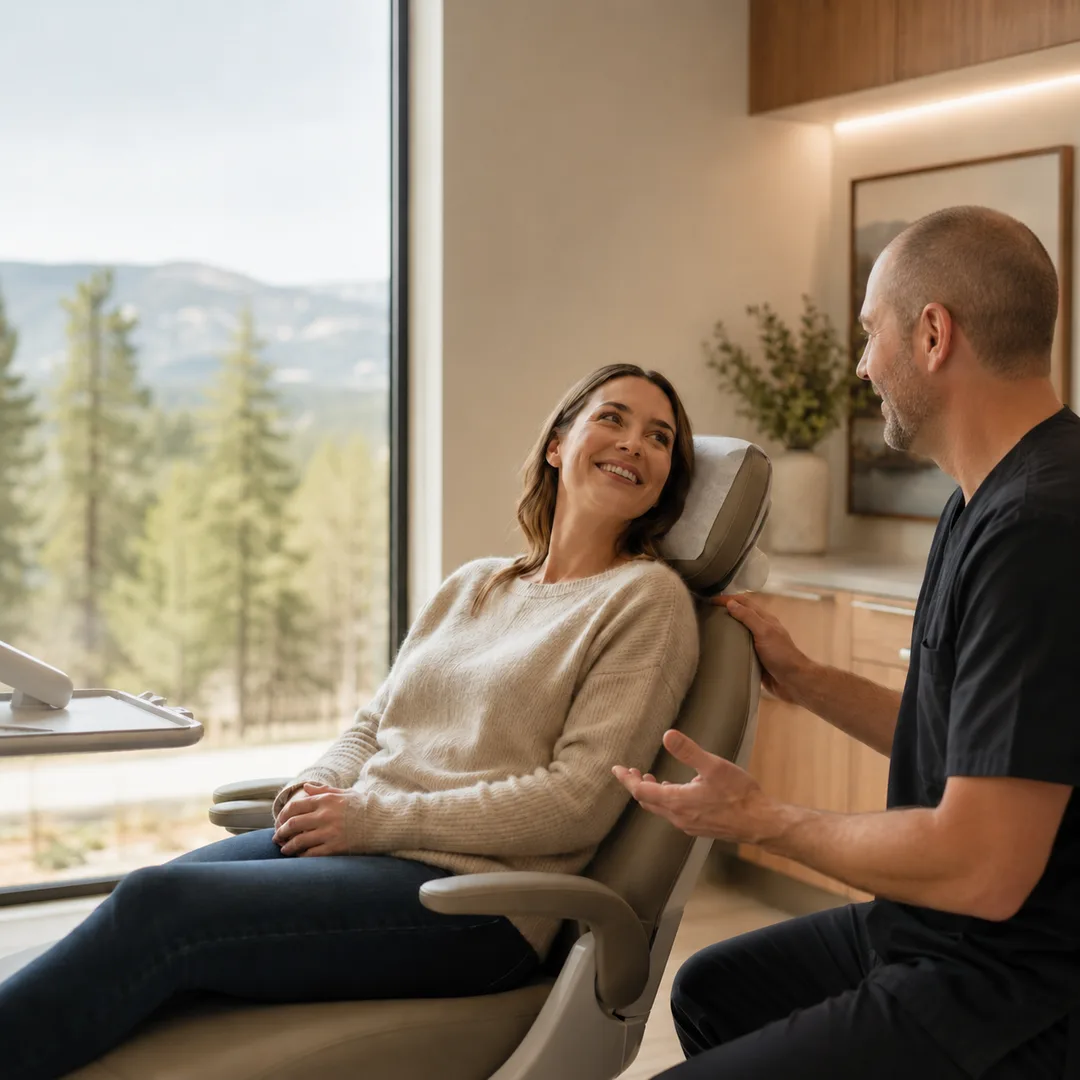
You can tell me what you are afraid of. You can tell me about a bad experience you had years ago. You can ask questions. You can see the office, meet us, and decide whether you feel comfortable here.
For someone who has avoided dentistry for years, walking into an unfamiliar office and immediately being placed in a dental chair can feel like an enormous first step. So we can make the first step smaller. Sometimes simply knowing who your dentist is — and knowing that your dentist understands why you are nervous — takes a surprising amount of fear out of the next visit. That personal connection matters, which is why I also wrote about the importance of getting connected to a dentist who genuinely cares.
Sometimes a Calm Environment Is Enough. Sometimes Sedation Helps.
There are patients who become comfortable once we slow the process down and establish trust. There are others whose anxiety is stronger. And that is completely okay.
When additional help is appropriate, we offer oral sedation using Halcion, the brand name for triazolam, a medication in the benzodiazepine family. It is taken as an oral medication before treatment to help reduce anxiety and create a calmer dental experience.
One of the most important things to understand is that this is not general anesthesia. You are not being "put under." With oral sedation, patients remain conscious and able to respond to instructions, although many become deeply relaxed and may remember little about portions of the appointment afterward. Some patients simply rest comfortably through their treatment. Others become relaxed enough that the appointment feels dramatically easier than dental visits they have experienced in the past.
Our goal is never to give someone more medication than necessary. The goal is to use the least intervention needed to help you feel safe and comfortable. You can learn more about how we use sedation on our sedation dentistry page.
What About Laughing Gas?
You may have heard of nitrous oxide — laughing gas — as an option for anxious patients. It isn't what we use here. The sedation method at Living Dental Health is oral sedation with Halcion, which I find more effective and which doesn't leave you with the groggy, residual hangover that nitrous can.
That said, sedation of any kind is only one tool. Some people don't need medication at all — what helps most is a calm pace and good communication. Whether Halcion makes sense for you depends on your medical history, your level of anxiety, and the type and length of treatment being performed. That is a conversation we have together. Sedation should support good dental care; it should never replace good communication.
Can You Drive After Oral Sedation?
No. When oral sedation is used, you will need a responsible adult to bring you to your appointment, take you home afterward, and remain available to help you for the rest of the day.
You should not drive, operate machinery, drink alcohol, or make important decisions while the medication is still affecting you. We will give you clear pre- and post-treatment instructions so you and your driver know exactly what to expect. By the following day, most patients are able to return to their normal routine, but every patient is different, and you should always follow the specific instructions provided for your treatment.
Our Goal Is Not to Keep You Sedated Forever
This may be the most important thing I can tell anxious patients about sedation: sedation does not have to be the destination. Sometimes it is simply the bridge that gets you there.
I have worked with patients who initially needed significant help just getting comfortable enough to sit in the dental chair. We started slowly. We talked. We developed trust. As their comfort increased, their need for sedation decreased. Eventually, some were able to complete dental treatment they never imagined they could handle without sedation at all.
I remember one patient who became emotional when I first placed something as simple as a dental mirror in her mouth. We did not push. We took our time. Over a series of visits, she became more comfortable. Her confidence grew. The amount of sedation she needed decreased. Eventually, she completed cosmetic dental treatment she had wanted for years without sedation.
That transformation is what I want for every fearful patient. Not simply getting you through one appointment — helping you reach a point where walking into the dentist's office no longer feels like something you have to fear.
Sedation Can Also Help With Longer Dental and Surgical Procedures
Dental anxiety is not the only reason we may discuss sedation. It can also be helpful for longer or more involved procedures, including certain cases involving:
- Dental implants
- Wisdom teeth removal
- Bone grafting
- Soft tissue procedures
- Other forms of oral surgery
Even patients who are not normally anxious about dental care may appreciate additional relaxation during a longer appointment. If sedation may be appropriate for your procedure, we will discuss your options, your health history, what you should expect, and what arrangements you will need to make before treatment. You can learn more about these services on our dental implants and oral surgery page.
You Do Not Have to Apologize for Being Afraid
One of the hardest things for me to hear is an anxious patient apologizing for being anxious. You do not need to apologize. You do not need to be embarrassed about how long it has been since your last dental appointment. And you do not need to somehow conquer your fear before contacting us. That is backwards.
Come to us with the fear. We'll start there.
Our job is not simply to fix teeth. Our job is to take care of the person those teeth belong to. Sometimes that means treatment. Sometimes it means sedation. And sometimes the most productive first appointment involves nothing more than sitting down together and having a conversation.
Start With a Conversation
If you have been putting off dental care because you are afraid, you do not have to begin with an exam. Start with a conversation.
Call Living Dental Health and tell us you have dental anxiety. Ask about scheduling a complimentary 15-minute meet and greet with Dr. Andy Engel. Come see the office. Meet us. Tell me what you have been through. Ask every question you need to ask. Nobody has to look in your mouth, and there is no pressure to start treatment. You are simply taking the first step toward making dentistry feel different than it has in the past.
We welcome new patients ages 12 and older at our Bend, Oregon dental practice, and we would genuinely love the opportunity to meet you. When you are ready, contact Living Dental Health.
No judgment. No rushing. No white-knuckling your way through an appointment. Just a calmer way forward.